

Big feelings, safe hands
For the youngest children. Six short activities that separate the feeling, which is allowed, from the hurting, which is not.
Free to download and print. Nothing to pay, no account needed.
What it is for
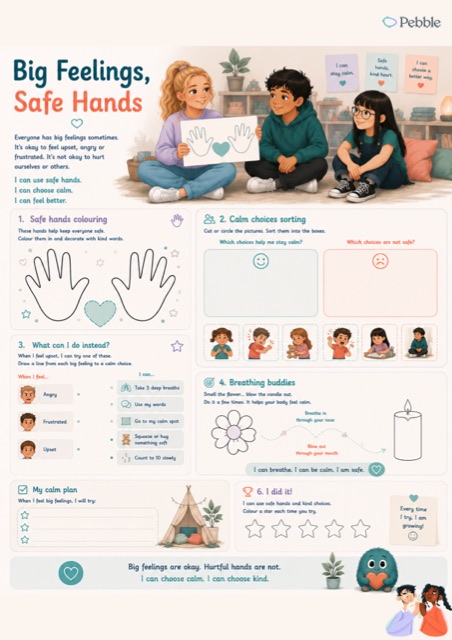
The whole sheet rests on one sentence printed at the top: “It’s okay to feel upset, angry or frustrated. It’s not okay to hurt ourselves or others.” Everything after it is practice at the second half without ever disputing the first.
There are six activities — colouring, sorting, matching a feeling to a calm choice, a breathing exercise, a calm plan and a star chart. It is far too much for one sitting with a three-year-old, and it is not meant to be done in one.
Using it in a session
- Do one activity, not six. Pick the one that fits the child in front of you today. The sheet is a menu, not a programme.
- Start with the colouring. Safe hands colouring asks nothing and settles most children. It earns you the attention the later activities need.
- Do the breathing with them. Smell the flower, blow the candle out. An adult doing it alongside is the difference between an instruction and a game.
- Let the calm plan be short. One thing a child will actually do beats three they agree to in the room and forget on the way out.
- The star chart is for trying. “Colour in a star each time you try” — trying, not succeeding. Keep it that way out loud.
A sheet can teach a three-year-old what to do instead. It cannot tell you why the big feelings are there, and that question is still yours.
What is on the sheet
- Safe hands colouring
- Calm choices sorting — what helps, what is not safe
- What can I do instead? — matching feelings to calm choices
- Breathing buddies — smell the flower, blow the candle
- My calm plan
- I did it! — a star for every try
Forty-nine worksheets, all free
Built in practice by a working social worker, for children, young people and the people around them. New sheets are added as they are needed.
See the full libraryFree worksheet
Where shall I send the next one?
The worksheets are free, and always will be. Leave your email and I’ll send you each new one as it’s added — direct work tools, and the occasional idea from practice. Nothing else, ever.
One list. New worksheets only. Unsubscribe any time.