

Social GGRRAAACCEEESSS
The one sheet in the library that nobody fills in with a family. A framework associated with John Burnham and colleagues for noticing how difference and power shape a piece of work, on a single side you can take into supervision.
Free to download and print. Nothing to pay, no account needed.
What it is for
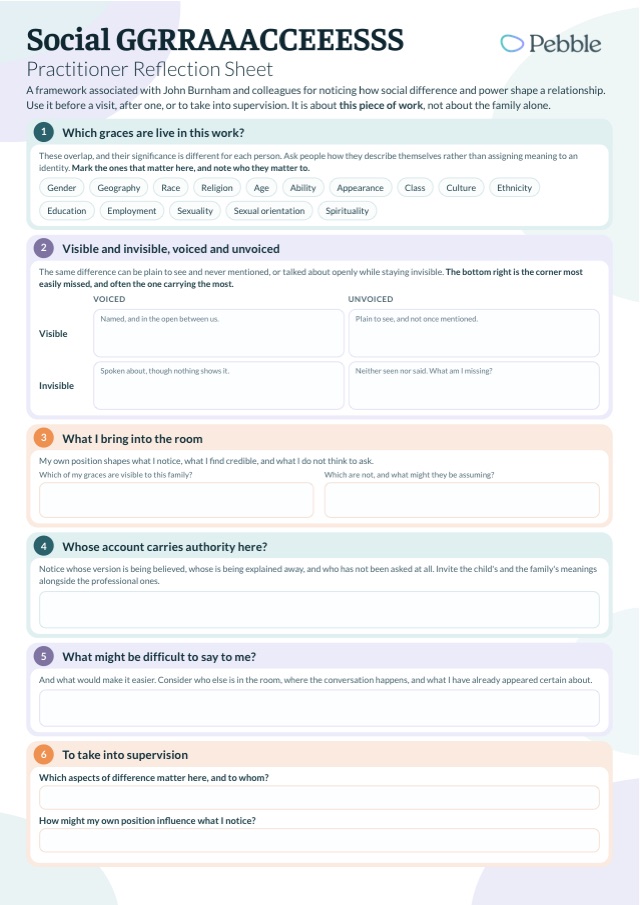
GGRRAAACCEEESSS is fifteen aspects of difference: gender, geography, race, religion, age, ability, appearance, class, culture, ethnicity, education, employment, sexuality, sexual orientation and spirituality. They overlap, and their significance is different for each person, which is why the sheet asks you to mark the ones that are live in this piece of work and note who they matter to, rather than working dutifully through all fifteen.
The centre of the sheet is the part that does the thinking: a grid of visible and invisible against voiced and unvoiced. The same difference can be plain to see and never mentioned, or talked about openly while staying invisible. The square that is neither seen nor said is the one most easily missed, and often the one carrying the most.
The rest of the page turns the framework back on you. What you bring into the room, whose account is being believed and whose has not been sought, and what a family might find difficult to say to you. It closes on two questions written to be read out in supervision.
Using it well
- Mark the graces, do not work through them. Fifteen is a prompt, not a checklist. Three that are genuinely live tell you more than all fifteen filled in politely.
- Leave the bottom right square until last. Neither seen nor said is the hardest one and the one worth the time. An empty square there is a finding rather than a blank.
- Answer what you bring into the room honestly. Your own position decides what you notice, what you find credible and what you do not think to ask. This is the square that is supposed to be uncomfortable.
- Ask who has not been asked. Whose account carries authority is usually easy to answer. Whose account nobody has sought is the one that changes a plan.
- Take the last two questions in, not the whole sheet. The closing pair are written to be read out. The rest of the page is your working.
The sheet asks you to describe what you notice, not to settle anything about a family from it. Ask people how they describe themselves rather than assigning meaning to an identity, and keep their own meanings alongside the professional ones rather than underneath them.
What is on the sheet
- Which graces are live in this work, with all fifteen to mark up
- Visible and invisible against voiced and unvoiced, as four squares
- What I bring into the room, and what this family can and cannot see of it
- Whose account carries authority here
- What might be difficult to say to me, and what would make it easier
- Two questions to take into supervision
Fifty-two worksheets, all free
Built in practice by a working social worker, for children, young people and the people around them. New sheets are added as they are needed.
See the full libraryFree worksheet
Where shall I send the next one?
The worksheets are free, and always will be. Leave your email and I’ll send you each new one as it’s added — direct work tools, and the occasional idea from practice. Nothing else, ever.
One list. New worksheets only. Unsubscribe any time.