

All About My Genogram
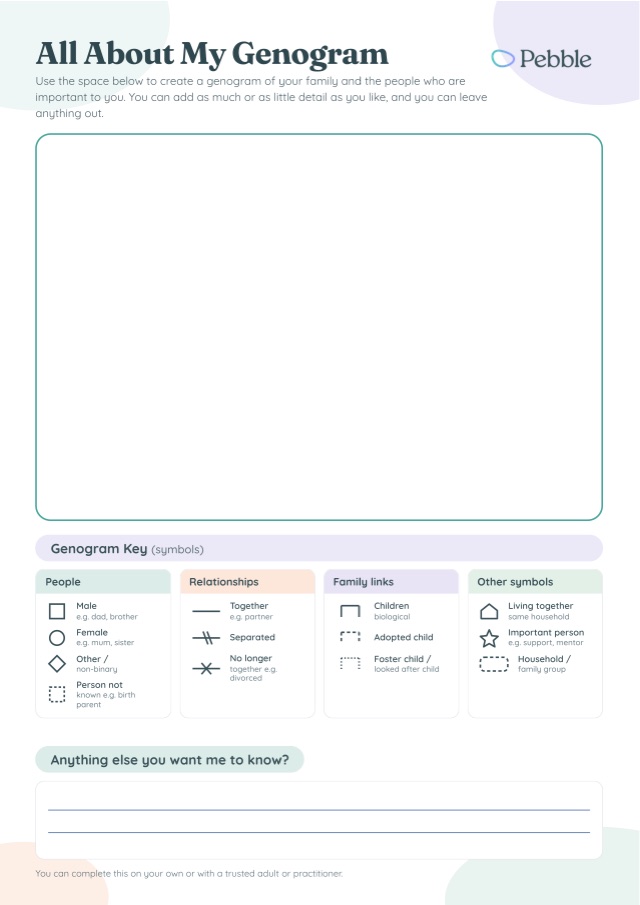
The same key with more room for detail: adopted and foster children, people who are not known, important people outside the family, and household groups, for a young person working on their own or alongside you.
Free to download and print. Nothing to pay, no account needed.
What it is for
This is the older version of the same sheet, and the difference is who holds the pen. It says so plainly: add as much or as little as you like, and leave anything out. A young person who is going to draw their family honestly needs to know in advance that they are allowed to stop.
The key carries the parts that matter to young people who have been in care: a person not known, which is how a birth parent is often honestly recorded, and separate symbols for adopted and for foster or looked after children. Those are not footnotes for this group. They are frequently the first thing they want on the page.
A drawn sheet is often where this starts and not where it ends. Pebble Genogram takes the same symbols onto a canvas, keeps multiple partners and households straight, and exports a copy with the key attached, which is what a report or a court bundle needs.
Using it in a session
- Offer it and then be quiet. Many young people will do this better on their own than with you talking. Hand it over, say you will be here, and let them work.
- Person not known is a real answer. It gives a young person a way to include somebody they have never met without having to explain or apologise for it.
- Ask about the household box last. Who lives with whom can be the hardest part for a young person who has moved. It is easier once the rest of the page exists.
- Important people are worth a second question. Ask what that person does, not just who they are. The answer is usually the most useful sentence on the sheet.
- Read the bottom box back to them. “Anything else you want me to know?” is written for somebody else to read. Checking you have understood it before it goes anywhere is the respectful way to use it.
What a young person draws here is their account of their family. It is not a verified record and it is not an assessment. Where it differs from the file, both facts are worth knowing, and neither one settles the other.
What is on the sheet
- An open space to draw the family
- Male, female, other or non-binary, and a person not known
- Together and separated
- Children, adopted children, and foster or looked after children
- Living together in the same household
- Important people outside the family
- Household and family groups
- Anything else you want me to know?
Fifty-one worksheets, all free
Built in practice by a working social worker, for children, young people and the people around them. New sheets are added as they are needed.
See the full libraryFree worksheet
Where shall I send the next one?
The worksheets are free, and always will be. Leave your email and I’ll send you each new one as it’s added — direct work tools, and the occasional idea from practice. Nothing else, ever.
One list. New worksheets only. Unsubscribe any time.