

My support network
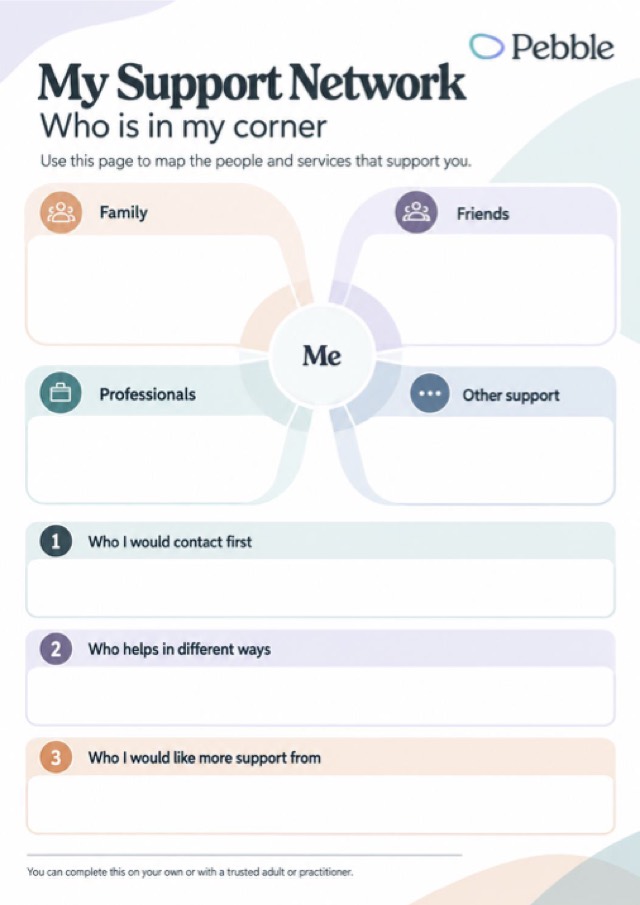
Family, friends, professionals and other support, mapped in four boxes around the young person, then who they would contact first, who helps in different ways, and where they would like more support.
Free to download and print. Nothing to pay, no account needed.
What it is for
The shape does some of the work. The young person is in the middle and everything else arranges itself around them, which is a different feeling from writing a list down a page. Four boxes also make absence visible: an empty quadrant is as informative as a full one, and you can see it at a glance rather than having to count.
The three questions underneath turn the map into something you can act on. Who they would contact first is a safety question. Who helps in different ways separates the person who listens from the person who turns up. Where they would like more support is the only part of the sheet that asks what is missing, and it is usually the part worth quoting back in a plan.
Using it in a session
- An empty box is information. Do not fill it for them. A young person with nothing under Friends has told you something. Writing a name in to make the page look better loses it.
- Professionals is often the fullest box. That is worth noticing out loud and gently. A network made mostly of people who are paid to be there is a particular kind of network.
- Question one is about what they would really do. Not who they ought to contact. If the honest answer is a friend rather than an adult, that is the useful answer.
- Question two separates listening from doing. Ask who they would ring at two in the morning and who they would ask for a lift. They are often different people.
- Question three is where the plan comes from. It is the young person naming the gap themselves, which is far stronger in a review than you naming it for them.
A full map is not the same as a safe one, and a thin map is not automatically a concern. What matters is whether the people named would actually answer, and the sheet cannot tell you that. Asking is still your job.
What is on the sheet
- Four boxes around the young person: family, friends, professionals and other support
- Who I would contact first
- Who helps in different ways
- Who I would like more support from
- A line saying it can be completed alone or with a trusted adult
Forty-nine worksheets, all free
Built in practice by a working social worker, for children, young people and the people around them. New sheets are added as they are needed.
See the full libraryFree worksheet
Where shall I send the next one?
The worksheets are free, and always will be. Leave your email and I’ll send you each new one as it’s added — direct work tools, and the occasional idea from practice. Nothing else, ever.
One list. New worksheets only. Unsubscribe any time.