

People who matter
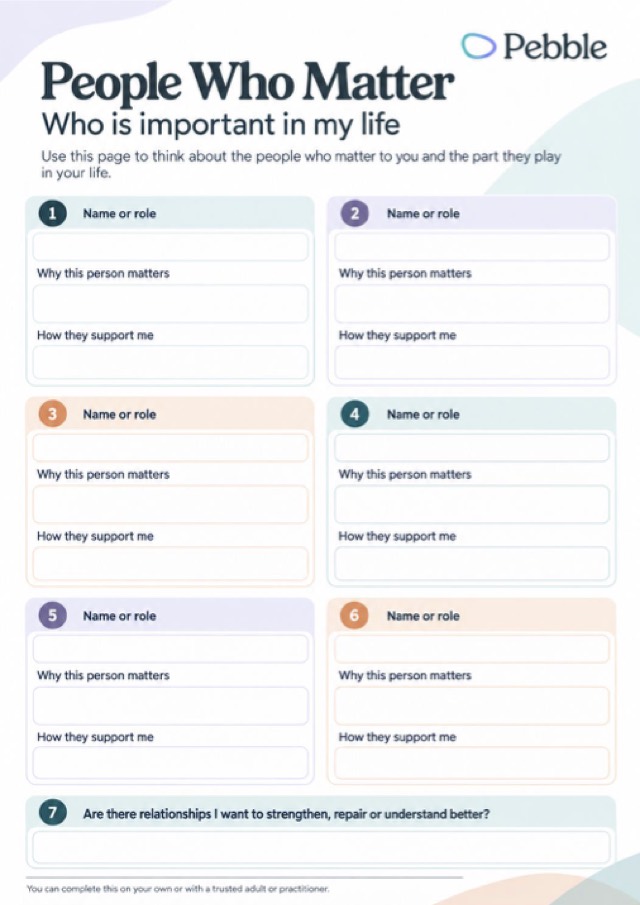
Six spaces for the people who matter to a young person, each asking why that person matters and how they help. It ends by asking which relationships they would like to strengthen, repair or understand better.
Free to download and print. Nothing to pay, no account needed.
What it is for
Most relationship sheets ask for a list of names. This one asks three questions about each person, which is what moves it past a register of who exists and into what each relationship actually does. A name on its own tells you very little. “My nan, because she never asks questions, she just feeds me” tells you a great deal.
The closing question is the one that earns the sheet its place. Strengthen, repair and understand better are three different asks, and a young person choosing between them is telling you where they think the difficulty sits. It invites repair without anybody having to name a problem first.
If you are mapping a whole family rather than the people around one young person, Pebble Genogram draws the same thinking as a family diagram, with households and relationships between everybody rather than six separate boxes.
Using it in a session
- Six boxes is a limit, not a target. Do not help them reach six. Three filled in properly are worth more than six half-written, and the ones they reach for first are the ones that matter.
- The second and third prompts are the work. Why this person matters, and how they support me. A young person who can answer the first but not the second is describing someone they love rather than someone who helps.
- A role is allowed instead of a name. “My mate’s mum” or “the man at the gym” are proper answers. Who the adults in a young person’s life actually are is often not who the file says.
- Slow down on question seven. Ask which of the three words they would pick and why. The answer is usually more specific than anything in the six boxes above it.
- It can be left with them. The sheet says it can be completed alone or with a trusted adult. Leaving it behind after a visit is a legitimate way to use it.
Six names does not mean a strong network, and one name with real detail may say more than six thin ones. A young person who cannot fill the first box is telling you something that belongs in your assessment, not on the sheet.
What is on the sheet
- Six spaces, each with name or role, why this person matters and how they support me
- A closing question about relationships to strengthen, repair or understand better
- A line saying it can be completed alone or with a trusted adult
Forty-nine worksheets, all free
Built in practice by a working social worker, for children, young people and the people around them. New sheets are added as they are needed.
See the full libraryFree worksheet
Where shall I send the next one?
The worksheets are free, and always will be. Leave your email and I’ll send you each new one as it’s added — direct work tools, and the occasional idea from practice. Nothing else, ever.
One list. New worksheets only. Unsubscribe any time.